

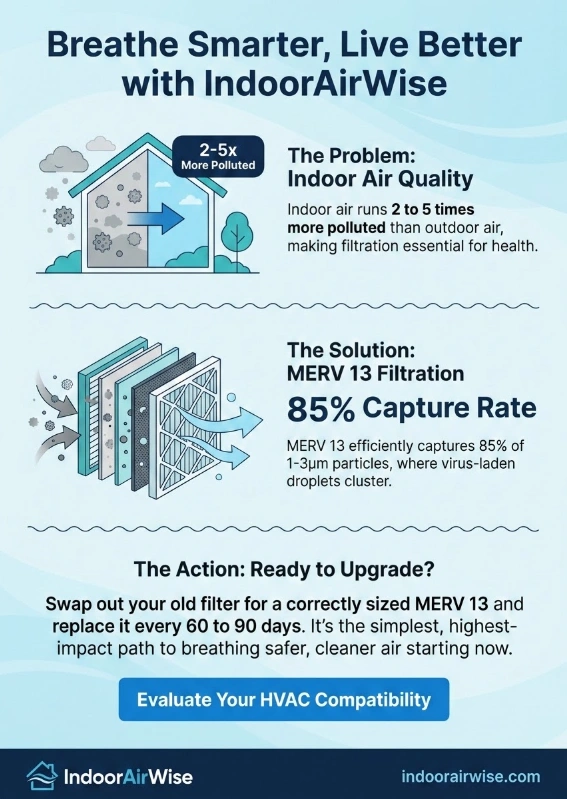
A MERV 13 filter captures 85% of respiratory droplets in the 1-to-3-micron range. That one fact is why ASHRAE recommends MERV 13 for home HVAC systems, and why, in our IAQ assessments, it’s almost always the highest-impact upgrade we see homeowners skip.
No, it isn’t a HEPA filter. Yes, individual virus particles are smaller than a MERV 13 can catch on its own. But viruses don’t drift through the air as free specks. They ride on respiratory droplets and partially dried droplet nuclei, and those droplets sit squarely inside the filter’s capture zone. Swap your MERV 8 for a correctly sized MERV 13, run the blower, and you’ll measurably cut the virus-carrying particle load cycling through every room in your house.
TL;DR Quick Answers
MERV 13 air filter for viruses
MERV 13 is the highest-rated filter most home HVAC systems can actually run. Tested under ASHRAE Standard 52.2, it captures 85% or more of particles between 1 and 3 microns, which is the size of most virus-carrying respiratory droplets. HEPA still wins on individual virus particles, but for whole-home protection you install today, MERV 13 is the strongest practical option. For side-by-side product specs, this MERV 13 air filter for viruses buying breakdown is worth cross-checking against manufacturer claims before you buy.
Top Takeaways
- MERV 13 captures 85% or more of particles in the 1–3 μm range, which is the size band where most virus-carrying respiratory droplets sit.
- It isn’t HEPA. HEPA hits 99.97% at 0.3 μm but needs dedicated equipment, while MERV 13 runs on a standard residential blower and stays the strongest filter most homes can actually install.
- ASHRAE recommends MERV 13 or higher for reducing airborne infectious aerosols in occupied spaces.
- Filtration is one leg of the strategy. Pair any air filter with outside-air ventilation, indoor humidity between 40% and 60% RH, and a portable HEPA unit in the room you sleep in.
- Check your HVAC manual before you upgrade. MERV 13 creates more airflow resistance than lower-rated filters, and an underpowered blower will tell you about it.
Table of Contents
The MERV 13 case, in plain language
How MERV 13 filters catch virus-carrying particles
Individual virus particles are small. Most measure 0.02 to 0.3 microns across, and almost none of them travel alone. They ride on respiratory droplets and partially dried droplet nuclei, which the CDC places between 1 and 5 microns. That’s the size band MERV 13 was engineered to catch.
Under ASHRAE Standard 52.2 testing, MERV 13 particle size filtration captures at least 85% of particles between 1 and 3 microns, and at least 50% of particles between 0.3 and 1 microns. In plain terms, those are the MERV 13 filter efficiency viruses numbers most industry sources cite, and they translate to a real drop in the virus-carrying particle load cycling through your HVAC system every hour. Run the air handler continuously and the filter will process every cubic foot of air in your home several times a day.
MERV 13 vs HEPA for viruses: the honest comparison
HEPA filters capture 99.97% of particles at 0.3 microns, which is the hardest-to-catch particle size in residential air. On paper, HEPA is the stronger defender against the smallest virus particles. The catch: HEPA media is dense, and the airflow resistance it produces exceeds what most residential blowers can push through.
That’s the trade-off in one sentence. HEPA wins on the spec sheet. MERV 13 wins on what you can actually install and run at home. In most households, the strongest real-world setup is a MERV 13 filter in the central HVAC plus a portable HEPA unit in the bedroom or main living space.
MERV 13 airborne pathogens guidance from ASHRAE
ASHRAE, the American Society of Heating, Refrigerating and Air-Conditioning Engineers, writes the governing standards for HVAC design in North America. On virus mitigation, the MERV 13 ASHRAE virus guidelines are direct. ASHRAE Standard 241-2023 (Control of Infectious Aerosols) and the ASHRAE Position Document on Infectious Aerosols both call for MERV 13 or higher filtration as a core layer of risk reduction in any occupied space.
The standard was written with commercial buildings in mind, but the principle scales down to residences without much translation. Dense enough filtration, circulated enough times per hour, cuts the concentration of airborne pathogens in the room.
Will your HVAC system handle a MERV 13?
This is where upgrade attempts typically go sideways. Denser filter, higher static pressure. If your system isn’t rated for that pressure, you’ll see reduced airflow, longer run cycles, and extra strain on the blower motor.
Before you install a MERV 13, run this five-step check:
- Find your HVAC manual or the model number on the air handler.
- Look up the maximum rated MERV for your system.
- Check the static pressure rating against MERV 13 specifications.
- Measure your current filter slot dimensions precisely. Depth matters, and a 4-inch filter outperforms a 1-inch at the same MERV.
- If any of the above is unclear, book a technician check before installing.
Choosing the right HVAC filter for virus removal
The MERV number on the box is the starting point, not the whole answer. Confirm the filter was tested to ASHRAE Standard 52.2 (the actual test methodology) rather than marketed as “MERV 13 equivalent” without the data. Check third-party certifications where the filter makes allergy or asthma claims. And match filter depth to your system: deeper pleats mean more surface area, lower pressure drop, and longer useful life.
For allergy and respiratory-condition households
When someone in your home has asthma, COPD, or another diagnosed respiratory condition, filtration decisions carry more weight. MERV 13 home air filter respiratory viruses data points to real reductions in circulating allergens and virus-carrying particles, though no filter treats a condition. This article is educational and doesn’t replace medical advice. Consult your physician for condition-specific guidance. Pair filtration with humidity between 40% and 60% RH, periodic duct inspection, and steady source control.
Replacement cadence
Replace a MERV 13 filter every 60 to 90 days under typical residential conditions. Go shorter during wildfire smoke events, in pet-dense households, or whenever visible loading is heavy. A loaded filter steadily builds airflow resistance, and timely replacement protects both your air quality and your HVAC equipment.
“Across the residential HVAC systems we assess, MERV 13 is consistently the upgrade with the highest measurable impact on indoor particle load, including virus-carrying droplets, without pushing the blower beyond its designed tolerance.”
7 Essential Resources to Go Deeper
If you’re making a MERV 13 decision for your home, these seven authoritative sources take you from filter-rating mechanics to verified product-performance data.
1. Understand how MERV works, straight from the EPA
U.S. EPA: What is a MERV Rating? The primary government source explaining what MERV ratings mean and what each level actually filters. Start here before any upgrade decision.
2. Get the EPA’s plain-language guide to home air cleaners
U.S. EPA: Guide to Air Cleaners in the Home Covers filter types, portable purifiers, and how to combine the two. A useful companion read for any MERV 13 decision.
3. Read ASHRAE’s infectious-aerosol position in full
ASHRAE: Position Documents The Position Document on Infectious Aerosols is the definitive engineering-society statement on filtration’s role in airborne-disease risk reduction.
4. Reference the exact standards your filter should meet
ASHRAE: Standards & Guidelines Hub page for Standards 52.2 (filter testing), 62.1 (ventilation), and 241 (infectious aerosol control). Cite these when evaluating any MERV 13 product claim.
5. Follow the CDC’s building ventilation playbook
CDC: Ventilation in Buildings The CDC’s framework for combining filtration, outside-air ventilation, and air exchange to reduce airborne transmission. It’s the broader context MERV 13 operates within.
6. Dig into NIOSH’s filtration and indoor-air research
NIOSH: Indoor Environmental Quality NIOSH research on filtration efficacy, ventilation, and occupational indoor-air health. Useful when you want the science behind the standards.
7. Verify portable air cleaner performance claims with AHAM
AHAM Verifide: Certified Air Cleaner Directory For readers pairing a portable HEPA unit with their MERV 13 setup, this directory cross-checks CADR and coverage-area claims against third-party testing.
3 Statistics That Reframe the MERV 13 Decision
A few numbers reshape how most homeowners think about this upgrade. These three are worth memorizing.
1. Indoor air runs 2–5× more polluted than outdoor air
The U.S. EPA Introduction to Indoor Air Quality reports that some indoor pollutants run two to five times higher than outdoor levels, and in certain cases more than 100 times higher. In our IAQ assessments, this is the single most underestimated number we encounter. The air you breathe most is the air most worth filtering, which is exactly what a correctly sized MERV 13 filter virus filtration setup addresses.
2. Virus-laden respiratory aerosols cluster in the 1–5 micron range
The CDC Scientific Brief on SARS-CoV-2 Transmission places virus-laden respiratory particles predominantly in the 1-to-5-micron range. That’s the band where MERV 13 capture is strongest, which is why MERV 13 COVID protection conversations keep pointing back to this filter class. A lower MERV leaves too many of those particles in circulation. A higher MERV, for most homes, can’t physically be installed.
3. Ventilation plus filtration is the proven combination
The WHO Roadmap to Improve and Ensure Good Indoor Ventilation frames filtration as one leg of a three-part approach. The other two are ventilation and air-cleaning technologies. No single measure eliminates airborne risk. Combined, the three cut the respiratory-particle load in a room far more than any single intervention. That’s the right way to think about MERV 13 in a real home: not a silver bullet, but the filtration leg of a three-leg stool.
Final Thoughts and Opinion
Across the IAQ assessments we work through, one pattern repeats. Most homes are over-treated on the product side and under-treated on the process side. People buy portable purifiers, park them in corners, and leave the central HVAC running a MERV 8 from five years ago. The highest-return upgrade on a typical residential system is almost always the unglamorous one: swap the old filter for a correctly sized MERV 13 and actually replace it on schedule. When the question is “what is the best MERV rating for viruses my home can actually use?” the answer for most households is MERV 13.
MERV 13 won’t cure a viral illness or guarantee you never catch one. It will measurably reduce the airborne viral load circulating through your rooms. Pair it with ventilation and humidity control, and you’ve built a system that protects you every hour the HVAC runs.
Frequently Asked Questions
Does a MERV 13 filter actually filter out viruses?
A MERV 13 filter captures 85% or more of particles between 1 and 3 microns, which is the size range of most virus-carrying respiratory droplets. It doesn’t catch individual virus particles (typically 0.02 to 0.3 microns) as efficiently as HEPA, but it meaningfully reduces the concentration of virus-carrying particles circulating in your air.
What MERV rating should I use for virus protection at home?
For most residences, MERV 13 is the highest MERV rating your HVAC system can practically run without airflow problems. MERV 14 through 16 performs better on finer particles but typically exceeds residential blower specifications and can damage equipment not rated to handle that level of resistance.
Is MERV 13 the same as HEPA?
No. HEPA captures 99.97% of particles at 0.3 microns but requires dedicated equipment most home HVAC systems cannot run. The strongest practical setup for most households is a MERV 13 filter in the central HVAC plus a portable HEPA unit in high-use rooms.
Can a MERV 13 filter protect against COVID-19?
A MERV 13 filter reduces the concentration of airborne particles that can carry viruses including SARS-CoV-2. No single measure eliminates transmission risk, which is why ASHRAE recommends MERV 13 filtration alongside ventilation, humidity control, and source reduction.
Does ASHRAE actually recommend MERV 13?
Yes. ASHRAE Standard 241-2023, the Position Document on Infectious Aerosols, and Standard 62.1 all support MERV 13 or higher filtration as a core layer of airborne-infection risk reduction in occupied spaces.
Will MERV 13 damage my HVAC system?
Not if your system is rated for it. Some older or underpowered residential blowers can’t handle the pressure drop a MERV 13 filter creates. Check the HVAC manual or book a technician visit before installing.
How often should I replace a MERV 13 filter?
Every 60 to 90 days under typical residential conditions. Replace sooner during wildfire smoke events, in pet-dense households, or whenever visible loading is heavy.
Breathe Safer, Cleaner Air: Start with Your Next Filter
Upgrading to a MERV 13 filter is the single highest-impact step most homeowners can take to reduce the virus-carrying particles they breathe every day. Check your HVAC compatibility, pick a correctly specified filter, and set a 60-to-90-day replacement reminder. That’s the simplest path to breathing safer, cleaner air starting now.